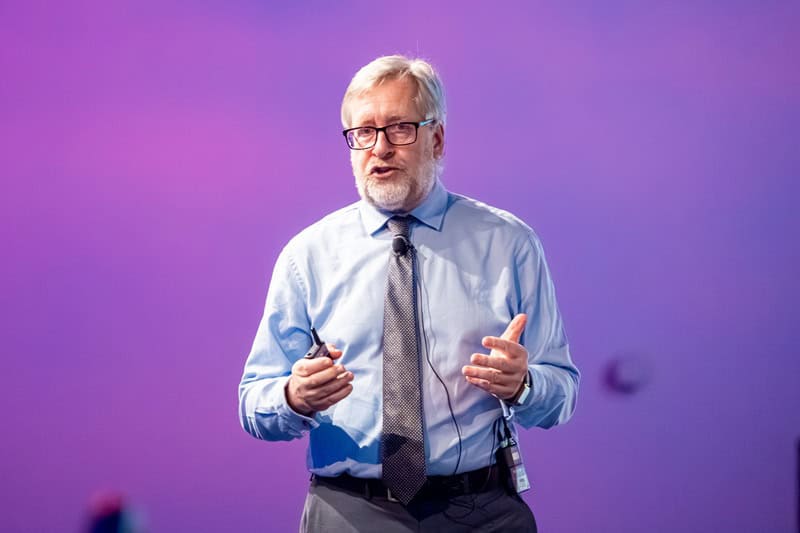
AI is not inevitable. It’s a choice. It is a decision each organisation must make depending on its own needs and, most importantly, the needs of the people it supports and cares for, Scottish Care Chief Executive Dr Donald Macaskill told an Australian audience at the ITAC 2026 conference in Brisbane this month.
He said while artificial intelligence had potential for aged care, it was important not to lose sight of what was important.
“It means remembering that aged care is not fundamentally about optimisation or efficiency. It is about dignity. It is about enabling people, including those living with dementia or frailty, to have voice, identity and humanity,” Dr Macaskill said.
“If AI helps us do that better, then it is worth exploring”.
Data itself is simply story, he said. “Data is the collected story of a person or a community. And if we forget that, then we risk stripping people of their humanity.”
“Hold fast”
For Dr Macaskill, born on the Isle of Skye, recognising the importance of connected community and the need to “hold fast” is integral to care.
He said, “So what does it mean to hold fast in the world of AI and aged care? There is enormous potential in AI. It enables prediction and pattern recognition. It can improve falls management. It can create efficiencies. It can reduce burden on overstretched systems.
“Most importantly, it has the potential to enable people to live more autonomous lives.
“In Scotland, we are moving away from the phrase “person-centred care” because, frankly, it has become empty language.
“Instead, we now talk about “person-led care”. The person is not simply sitting in the middle while professionals operate around them. The person is in control. Their choices, voice and decisions take priority. AI potentially allows us to move further toward that vision,” he said.
Ethical use of AI
Dr Macaskill said he had been involved with the University of Oxford Centre for the Ethical Use of AI since February 2024.
“One of the first things the centre recognised was that the greatest risks of AI emerge in areas of vulnerability, which is why social care became one of its priorities.”
Over nine months, providers, trade unions, ethicists, lawyers, advocates, regulators and people using services worked together to develop the Oxford Statement on the Ethical Use of AI.
One of its clearest conclusions was: If AI is only about efficiency and saving money, then we have already started in the wrong place.
Dr Macaskill said, “AI must be able to demonstrate that it improves wellbeing, strengthens equality and respects humanity. If it cannot do that, then don’t use it.
“Progress that requires us to abandon our humanity is not progress.”
Dr Donald Macaskill was also interviewed by hosts Dr Louise Schaper and Dr George Margelis on the latest episode of PULSE the Podcast – Hold Fast: AI, Humanity and the Future of Aged Care.