The ACT Government has published the first Digital Health Record (DHR) Benefits Realisation Yearbook, which details the impact of the electronic record system three years after go-live.
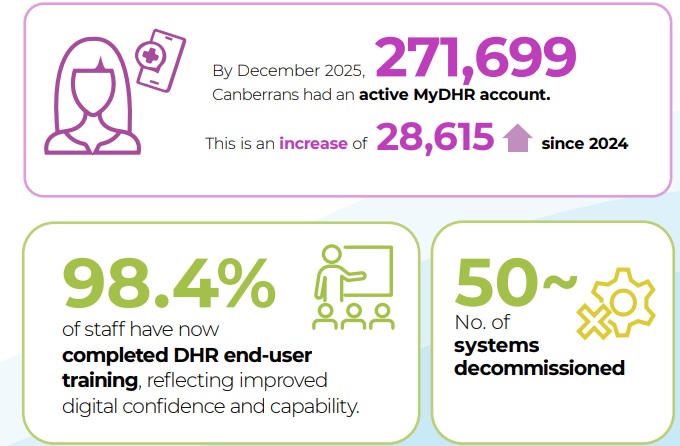
The yearbook shows the DHR has consolidated over 50 legacy systems into a single integrated platform. More than 271,000 people have an active MyDHR (the patient portal for DHR) account, with an average of 33,179 logins to the app per month.
The yearbook included a collection of case studies, patients and clinicians stories, and data from the past three years to highlight what is working well, as well as future focus areas.
Highlights:
- Almost 90,000 unnecessary blood draws were avoided last year.
- Over 826,000 results were sent directly to patients’ MyDHR accounts within 24 hours of a test being taken. For outpatients, the same-day release rate was 85%.
- Digital medication management and real‑time alerts prevented more than 270,000 potential errors.
- Almost 3.9 million secure messages were sent between doctors and care teams last year.
- More than 98% of public health staff have completed training to improve their digital confidence and skills using DHR.
Minister’s comments
Minister for Health Rachel Stephen-Smith said the DHR had helped Canberrans feel more informed and confident throughout their health journey, with access to appointments, results and direct communication with health workers in one convenient place.
“The Digital Health Record has transformed clinical care across the ACT public health system, making it better connected, more efficient, accessible and transparent,” Minister Stephen-Smith said.
“What we see in this report is that the Digital Health Record is more than an IT platform – it’s a key to supporting our clinicians to deliver high-quality, person-centred care.
“Having a single, secure, integrated record for each patient supports our health workers to build a clearer picture of someone’s health needs so they can deliver safer, more coordinated care, while also empowering Canberrans to be active partners throughout their health journey.
“Easy access to health information enables Canberrans to take an active role in their care with more informed questions, shared decision making, and more meaningful conversations with health workers—especially for those managing ongoing or complex health needs.
“It has supported the prevention of unnecessary blood draws, provided earlier alerts of potential adverse medicine reactions, improved the transparency of patient wait times at hospitals and walk‑in centres, and enabled better decision‑making and flow in our emergency departments.”
The report says the DHR has been moving from implementation to continuous improvement, deeper integration and clearer measurement of benefits.
Optimisation phase
“As of November 2025, the DHR is now moving into its optimisation phase. The focus will be on refining functionality so the DHR is easier to use every day, deepening integration so care feels more connected and embedding a structured approach to measuring benefits so patients, staff and the community can see the value being delivered”, the report states.
“The ACT Government is listening to feedback from health workers and Canberrans to continue to improve their experience and provide safer, more timely care at our hospitals, community health centres and walk-in centres,” Minister Stephen-Smith said.