Telstra Health is calling for a rethink of how clinical information moves between healthcare providers, warning that disconnected systems continue to create unnecessary work for GPs and practice staff.
Speaking at the Australian Association of Practice Management (AAPM) conference in Brisbane, Telstra Health clinical director and practising GP Dr Pratiksha Nirmal and product lead Cameron Sampson outlined how disconnected systems continue to create additional work for clinicians and practice staff – despite widespread digitisation.
Mr Sampson said Australian healthcare had largely moved beyond paper records and was now in a second stage of digital maturity, with systems increasingly able to exchange information.
However, he said these connections required manual intervention whenever something went wrong.
“As soon as there’s any issue at all, manual intervention is required. But the important part and the future piece that we want to get to, that not everyone is thinking about just yet, is being able to reuse that information with context,” Mr Sampson said.
“It’s very different to just reusing loose information. Loose information is why every John Smith comes up a million times in every system, because there’s no actual context of who that John Smith is, right? You need that clinical context of the record to come with you across different settings throughout the industry.”
He said this approach could support shared patient summaries, pre-populated clinical forms, automated pathology requests and better visibility of referrals and results.
One example was patient registration, where practices currently enter demographic information manually before retrieving clinical information from sources including My Health Record and the Australian Immunisation Register (AIR).
Mr Sampson outlined a future process in which practices would enter only the information required to identify a patient, with relevant information then retrieved automatically.
“So you don’t need to go chasing My Health Record or AIR or Medicare Online. It’s all just going to come together. One patient, one view into one connected system,” he said.
PMS Evolution
The speakers also outlined how practice management systems could evolve beyond storing appointments, billing information and clinical records to support connected workflows across multiple locations and healthcare providers.
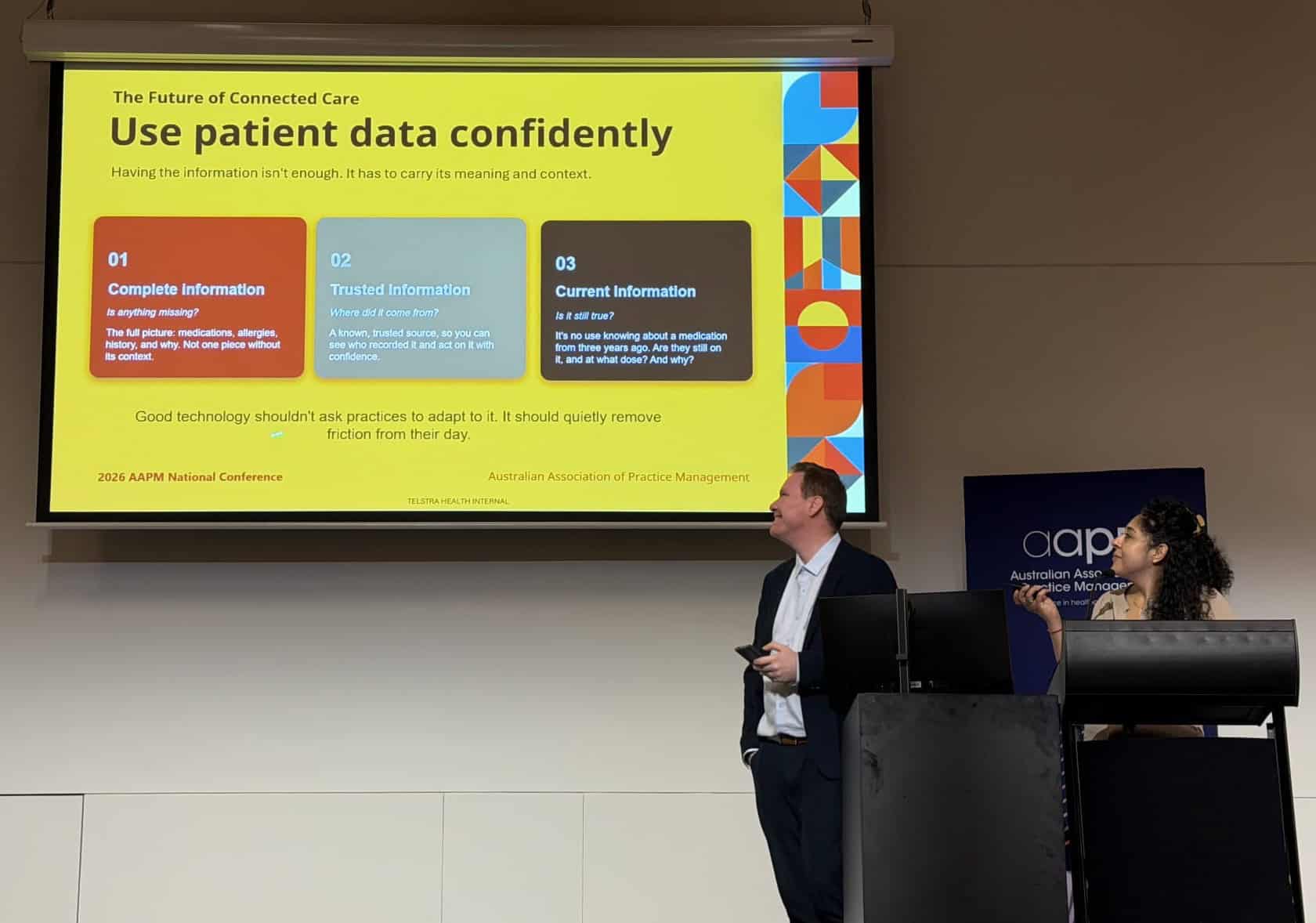
Dr Nirmal said access to complete, current and trusted clinical information was essential to improving care.
“When I make a clinical decision, I need to trust the information in front of me. Not just that it exists, but that it’s right and that it’s current,” she said.
“Is anything missing? I need the full picture. Medications, allergies, history and why it matters. Not one piece without context.”
She said information needed to retain its clinical meaning, including the source of the information and whether it remained current.
Fragmented impact
The speakers also highlighted the impact of fragmented care on the general practice workforce.
Citing the RACGP’s 2025 Health of the Nation report, Dr Nirmal said almost 80 per cent of GPs were dissatisfied with the administrative work associated with their jobs, up from 70 per cent in 2024.
The report also found 28 per cent identified referrals as an administrative process that could be improved, while 41 per cent reported issues with care coordination and communication with external healthcare providers.
“Fragmentation is both a patient care problem and a workload problem. And when healthcare services don’t connect effectively, general practice is left to bridge the gaps,” Dr Nirmal said, adding “This is leading to burnout in our workforce.”
The RACGP report found 33 per cent of GPs planned to stop practising within five years, while 63 per cent were considering reducing their practising time. Dr Nirmal acknowledged these figures did not establish that fragmented care was responsible for workforce attrition.
Mr Sampson said connected systems could also support larger general practice organisations by making patient information available across multiple sites, without requiring them to replace their existing practice management systems.
He said the broader approach could eventually support unified booking, centralised billing and population health programs.
Mr Sampson said the aim was not just to develop better software or undertake another integration project, but to ensure clinical information was already available, trusted and in context when needed.
Dr Nirmal said clinicians needed complete information at the point of care, with “one patient, one view.”
“Good technology shouldn’t ask practices to adapt to it. It should quietly remove friction. Having the information isn’t enough. It has to carry its meaning and it has to have context. That’s what we’re building towards,” she said.