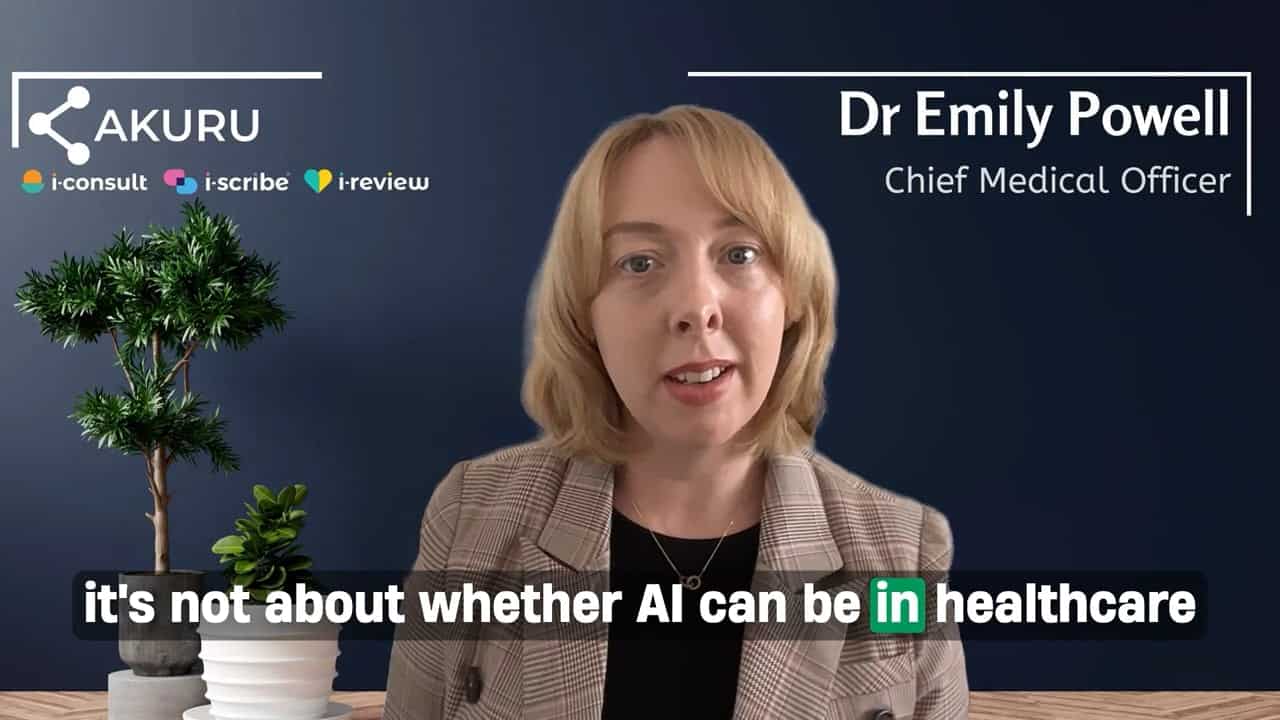
Play to hear Dr Emily Powell introduce this article.
AI in healthcare can be safe, it can be ethical, and it can be transformative when it’s built the right way, says Australian startup i-scribe. “It is not about replacing clinicians, it’s about protecting them and supporting sustainable practice and improving quality care at scale”.
The clinician-led AI medical scribe uses ambient listening to generate clinical notes, letters and summaries in real-time.
i-scribe Chief Medical Officer Dr Emily Powell has been part of the team from the start. She says governance, safety and ethics are built into the DNA of the doctor-led leadership team.
“I mostly work with hospitals and larger organisations on making sure that their governance goals are achieved and that i-scribe and AI use within the hospital system is appropriate for them and they’ve got all the systems in place so that they can use it effectively and safely,” Dr Powell told Pulse+IT.
One of the goals of i-scribe, she says, is changing the face of medical communication in Australia.
“I think when you’re in a high-pressure environment, and you’re trying to get a certain message out to a patient, and then you’ve got a million things on your mind, anything that can improve that communication is game-changing,” she said.
“And when it comes to building trust, clinicians especially have come to understand that it’s not about whether AI can be used in healthcare, it’s how it can be used in healthcare safely and appropriately and ethically.”
“People generally have a very good understanding of how it works, but it is the whole black box element that they want to know more about – particularly around data sovereignty, privacy and patient consent.
“It is incredibly important that those questions are asked and that clinicians are the ones who lead the way in answering and supporting other clinicians in getting the right information on that.
“The AI scribe is not there to replace their workflow and it’s just there to augment it.
Key benefits
Dr Powell says time-saving is one of the top benefits reported by clients. “ We find that clinicians save between 30 minutes and two-and-a-half hours a day using i-scribe so that contributes to reducing burnout.”
“Clinicians being able to leave on time instead of having to stay back and complete notes is huge because it supports work-life balance.
There is also the benefit of better communication with patients. “So if you have ambient listening mode, you can look your patient in the eye. You don’t have to type while you talk to them. You can also give them a document that explains in very simple language everything you talked about in the consult, all the questions they asked, so that they have a set of information about what they’ve discussed to take to their carers and family.
i-scribe is also enabling clearer communication, stronger rapport and more equitable care for culturally and linguistically diverse (CALD) communities.
Doctors who were interviewed reported using i-scribe during consultations conducted in Arabic, Hindi, Cantonese, French and mixed-language conversations, allowing patients to express themselves naturally rather than struggling through English.
“If patients are forced to speak English, the appointment can take much longer just to get the words out,” one clinician explained. “Speaking in their mother tongue changes the whole dynamic.”
Crucially, clinicians said that automated note-taking allowed them to maintain eye contact and focus on listening, something that is particularly important in cultures where attentive presence is closely tied to trust.
“I love that I don’t have to stare at the screen,” one doctor said. “I can actually look at the
patient and connect – and everything is still recorded.”
Dr Powell agrees. “No more dictaphones. A faster turnaround with referral letters just dictating into i-scribe, there’s no wait for the turnaround for typists for several weeks. Letters get back to referrers instantly.
“That means that referrers can follow up with patients faster and it reduces the bottleneck and lack of information between healthcare providers.
“As practicing doctors, we understand the different workflows very well, and so we can make changes quite dynamically and more in line with what individual clinicians want to have in their day-to-day.”
Building trust
Dr Powell said underpinning i-scribe was the major benefit of data sovereignty – “all data is stored and processed in Australia.
“Data sovereignty is extremely important, especially for hospitals and larger clinics. We want people to see, i-scribe as a long-term piece of clinical infrastructure,” Dr Powell said.
“I think we’re at the very beginning of AI in healthcare journey. We need to put standards in place so that people do have the correct information and people do have the opportunity to be able to ask questions and be trained on safe and ethical AI use from the very beginning,” Dr Powell said.
She said i-scribe users have a free trial and are given information on data sovereignty and privacy and how to consent patients.
“And everybody who signs up to i-scribe has an individual manager they can go to with questions. So as those questions shift more to ‘how can I use this even better’, then that person is there to support them.”