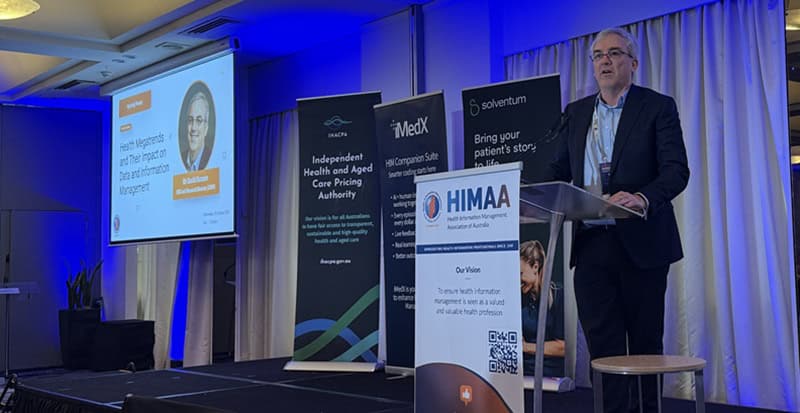
Australia is already using Sparked FHIR accelerator outcomes to drive innovation, the National Health Information Management Conference heard today.
Calling out the revamped Australian Cardiovascular Disease Risk Calculator as one example, Dr David Hansen, CEO and Research Director of the Australian e-Health Research Centre at CSIRO, said the Heart Foundation wanted a “single calculator that everyone could use”.
“We were able to build a calculator using the SMART-on-FHIR standard which extracted data out of the GP record system using FHIR. We need the GP systems to be fully FHIR compliant and provide that FHIR API. But because they’re all part of the Sparked program, they’re doing that,” Dr Hansen told delegates.
“If there’s some data missing, the clinician can still enter that. And then the nice thing is that it writes back into the GP system as well.
“That’s an example where we’re already building on the outcomes from the Sparked program to support clinicians and patients at the point of care – and as an example of how you don’t have to enter all the data. We’re using data from the clinical record and in the standardised way.
“That leads into all sorts of possibilities of what we can do with patient data to support them at the point of care as well as use that data elsewhere,” Dr Hansen added.
Sparked builds on a standard called FHIR – fast healthcare interoperable resources – which is increasingly how data is shared and exchanged in healthcare.
“So the data that goes into electronic health records, probably isn’t at the moment structured using FHIR resources, but when it’s shared, it’s going to be increasingly shared using FHIR as the official exchange between systems,” Dr Hansen said.
He said electronic health records are going to become increasingly “not just somewhere to store data and to retrieve data”, but to run algorithms on top of the data and provide apps for clinicians to use.
“ As they are using the electronic health record, they’ll be able to- like we do on our phones – use apps that take data out of the electronic health records, calculate something, provide some decision support and write back into the electronic health record,” he said.
Dr Hansen emphasised that Sparked is a “community process”.
“We’re working with the Australian Digital Health Agency, with the Department of Health and Disability and Ageing, as well as HL7 Australia. And we’ve managed to build a community of over 1,000 people who have participated around Australia.”
MEGATRENDS
Dr Hansen described four trends happening in digital health.
Interoperability – “the ability to move data around with meaning. It’s really important that as we do move data between systems, systems understand what that data is and what it means and how it fits into whatever the records that the data is going into.”
Cloud – “it is going to be really important to leverage the ability to build on professional organisations, whether that’s public cloud or private cloud, and use those systems to attain a level of cyber security and privacy and security that you probably can’t get at a more localised level.”
Apps and personalisation – “another trend that we’re seeing, the ability to not ‘send data out for analysis’ but to have that ‘analytics come to the data’.
AI and machine learning (ML) – “whether that is AI scribes, or the more traditional AI and machine learning building on datasets that are well curated, we can build machine learning algorithms to analyse images or increasingly genomics and other data. Those sorts of algorithms are starting to be better accepted now people are becoming more educated about exactly what AI is.”
Dr Hansen told the conference the field of AI and ML was moving “incredibly fast”. A project was underway at the Queensland Children’s Hospital around using genomics and AI together to find potential case studies of drugs or treatments that have been used for children with childhood cancer.
Dr Hansen said a report “AI trends for healthcare” was available from CSIRO.
The National Health Information Management Conference is presented by the Health Information Management Association Australia and continues Thursday 30 October and Friday 31 October.