


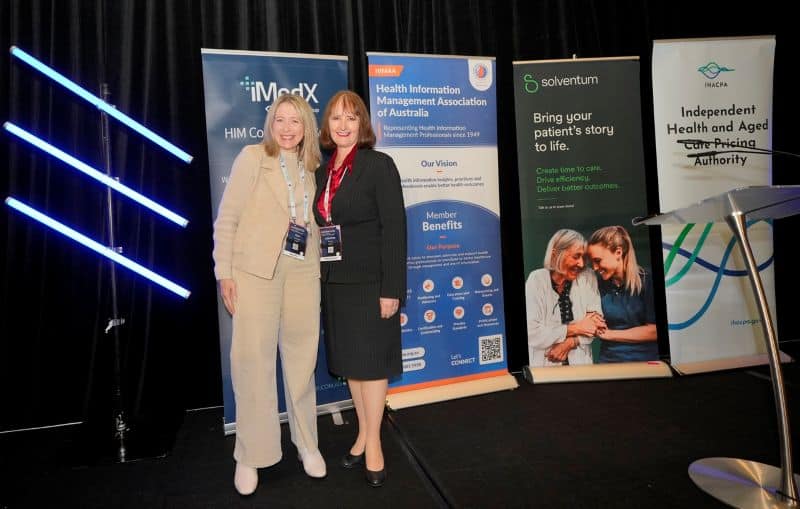
Health information professionals have a central role in shaping how healthcare uses artificial intelligence, with growing opportunities in data quality, validation and governance, American Health Information Management Association (AHIMA) President and Board Chair Thea Campbell told delegates at the HIMAA 2026 conference in Sydney.
Ms Campbell, MBA, RHIA, FAHIMA, has more than 30 years’ experience in health information, including leadership roles at Cedars-Sinai and Stanford Health Care. She is also Global Senior Director, Consulting, Outsourcing and Revenue Integrity at Solventum.
In her keynote, The Future Health Information Professional: Leading Through AI, Automation and Workforce Transformation, she drew on her experience implementing computer-assisted coding to outline eight key messages for the profession:
1. Trusted health information is our territory
From ambient scribes to AI-assisted coding, new technologies create, move, transform or depend on health information. Their value rests on whether that information can be trusted, Ms Campbell said, adding that health information professionals’ understanding of the quality, context and limitations of data placed them at the centre of this work.
“AI doesn’t move us off that field. It really puts us in the centre of that field.”
2. Every technology project becomes a people project
Introducing AI changes roles, processes and workflows. Supporting people through those changes is a leadership responsibility, Ms Campbell said.
“Involving staff early gives them a voice in implementation and helps identify practical problems. It also builds the trust needed for people to speak up when something goes wrong. Every technology is really a change to people, process, and workflow.”
3. Take workforce concerns seriously
AI is moving beyond beyond pilot projects into operation workflows, Ms Campbell said, noting “It’s no longer, how will healthcare organisations use AI? But it’s, how will they implement it safely? Govern it effectively? Concerns about job security and changing responsibilities deserve an honest response.”
“AI is not coming for your job, it is really changing how we are going to do it,” Ms Campbell said.
4. Know the story behind the data
Before data is used in an AI model, health information professionals should ask why it was collected, how accurate and complete it is, whether it contains bias and what level of risk its proposed use carries.
Ms Campbell said understanding those limitations was central to data stewardship. Incomplete documentation, copied text and information collected for a different purpose can influence AI outputs.
“At the end of the day, the technology changes, but really the foundations of what we need to do don’t. Today it might be AI-assisted coding. Tomorrow, it might be semi-autonomous. The day after that, it might be autonomous. Or some combination of all three all at the same time. And in between, there will be several versions, there will be upgrades, and all sorts of new products that none of us can predict.”
5. Measure more than productivity
Ms Campbell said her early experience with assisted coding focused on speed, productivity and the number of records processed. Those measures were useful but incomplete.
Organisations also need to monitor information that fails initial checks, cases the technology handles correctly, and unexpected results requiring expert review.
Staff need time to investigate those results and a clear way to report problems so systems can improve.
“It’s really important to define the measures of success for the workforce, not just the throughput of the tool.”
6. Prepare for a broader coding role
Ms Campbell described a shift from reading documentation and assigning codes towards validating and auditing technology’s outputs, alongside responsibilities in data quality, analytics and AI governance.
These roles require investment in skills and ongoing feedback to improve systems as documentation, classifications and technology change.
“You don’t have smaller jobs. You have bigger jobs. You have bigger jobs with higher level skills.”
7. Build judgement alongside technical skills
Judgement, curiosity, problem solving and persistence are essential to recognising when an AI-generated result does not make sense and investigating why, Ms Campbell said. She raised a challenge for education and workforce development: ‘how will new professionals build that judgement if technology performs the initial work?’
“If AI is doing the first pass, how do we train new people to recognise what is right and what is wrong?”
“I think the big question for the profession right now is how do you teach people those levels of skills if they didn’t do the work to start, right? If you’ve never coded, and I would say with a code vote, but with an encoder, how do you know if the answer the computer’s giving you is right or wrong, right? And that is our struggle.”
8. Help shape the decisions
Health information professionals need a voice in how AI tools are set up. Ms Campbell encouraged members to bring concerns to the table so teams could understand risks and agree on appropriate safeguards.
She urged delegates to consider what they and their teams needed to work effectively, whether that was training, access to data, time for review or greater involvement in implementation.
Her closing call was for individuals to stay curious, leaders to invest in their people, and the profession to secure a place at the AI governance table. She also encouraged Australian and US colleagues to share their experiences and learn from one another.
“As leaders, we need to lead the change and invest in our people. And as a profession, we need to make sure that we have a seat at the AI governance table. That we are the ones that are telling the story of that data,” she said.


