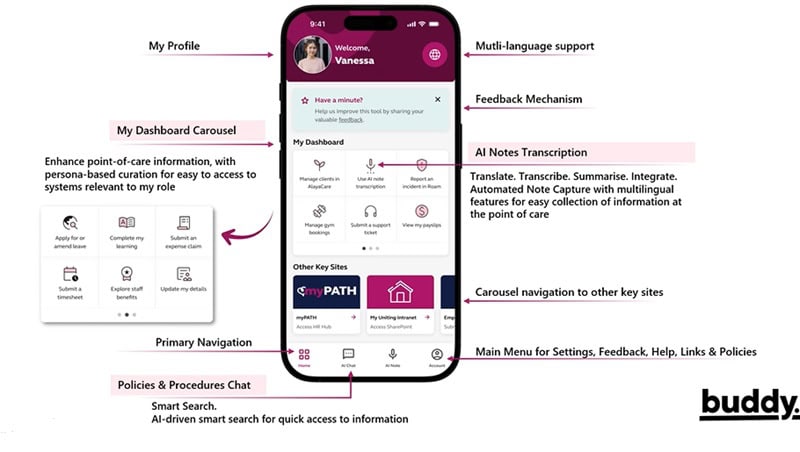
Uniting NSW & ACT says its generative AI assistant “Buddy” is now live in production across 1,000 community care workers, with staff reporting time savings of up to two hours a day through reduced administration.
Twelve months after first outlining the concept publicly, the not-for-profit says the tool has moved from pilot to frontline deployment, with measurable impact on documentation workflows and multilingual support.
“Buddy” this month earned Uniting a gold Asia Pacific Stevie Award for innovative achievement in digital transformation in a non-profit. Uniting NSW & ACT chief digital information officer Andrew Dome was presented with a gold award for most innovative technology leader of the year.

“It’s gone really, really well”, Andrew Dome said in his presentation during February’s Digital Transformation Tech Talk webinar, presented by the Department of Health, Disability of Ageing.
“About 12 months ago we were talking about what we were building. Now we can talk about what we built, what’s in production, and what our employees are currently using.”
Cutting documentation time
According to Mr Dome, the biggest efficiency gains are coming from post-visit documentation.
“The majority of the administration burden removal happens when they come out of seeing a customer in their home,” he said.
“Typically that would take 10, 15 or 20 minutes to type up. Now they’re telling us it takes half a minute to a minute.”
Uniting says frontline feedback suggests workers are reclaiming one to two hours a day, time that can be redirected into care delivery rather than compliance tasks.
“It’s removing a lot of administrative burden,” Mr Dome said. “They’re telling us they’re getting one to two hours back in their day, which for us means better quality aged care for our customers.”
And he was explicit the tool is positioned as ‘augmentation’, not replacement.
“We are a not-for-profit. This isn’t about taking head-count out. It’s about augmenting and reducing administration burden, certainly not replacing people.”
Designed with frontline input
Rather than launching AI as an IT-led experiment, Uniting ran discovery workshops and hackathons across the business.
“We went to the business and asked, ‘What are the key problems you’re trying to solve?’” Mr Dome said.
“We came up with 50 use cases, narrowed them down to 10, and focused on the top three. which became our first generative AI use cases, and they’re live in Buddy right now.”
He said involving frontline staff early shaped the way the AI assistant was configured.
“The IT people were prompting it with certain questions for the generative AI chat side, and when we got our business team to come in – the front line workers – they asked completely different questions because they’re at the front line and they actually want to know different things from what IT does,” Mr Dome said.
Multilingual and mobile
The mobile-based assistant supports 50 languages, addressing workforce diversity in community care.
“We have a high percentage of our frontline workforce from Nepal,” Mr Dome said.
“They can speak in Nepalese, it converts into English, and then it’s entered into our clinical system at the back end.”
A thousand community care workers now have the tool on their phones, with Uniting tracking usage patterns and survey feedback to refine functionality.
Security first
Mr Dome said governance and data controls were foundational to the rollout.
“We took a cautious approach. We made sure we knew where our data was, what we were trying to access, and that the access controls were in place.”
“This is persona-based. It basically means if you have access to that data now, you get access to that data by a Buddy. If you don’t have access to that data now, you won’t get access to it by a Buddy.”
The system was run through the organisation’s security program, including integration testing and user acceptance testing, before deployment.
“If you don’t know where your data is or haven’t classified it, make sure you put those security controls in place before wider deployment,” he said.