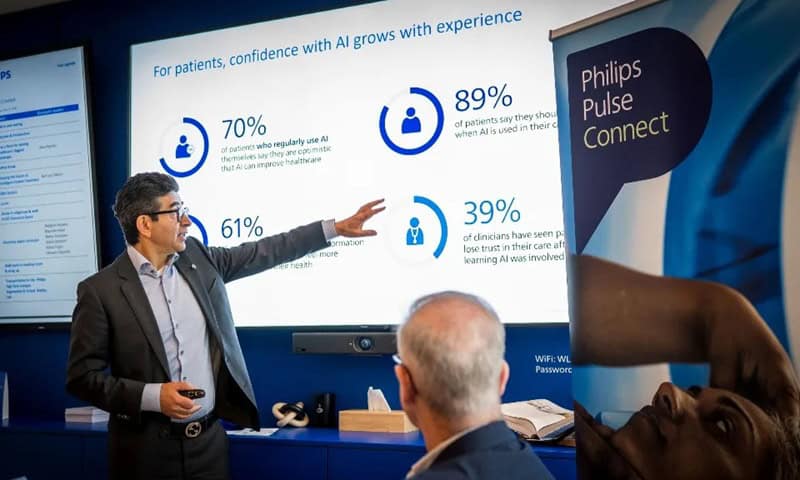
Healthcare professionals across Europe and the UK are reporting noticeable benefits from AI – however, according to the latest Future Health Index from Philips, the pace of adoption still varies between countries.
Europe-based healthcare professionals expressed differing levels of confidence in the readiness of their organisations to support AI – with sixty-three per cent of respondents in the Netherlands agreeing their organisation was prepared for AI adoption, compared with 60 per cent in France, 56 per cent in the United Kingdom and 50 per cent in Germany, against a global average of 64 per cent.
The report also found that in the UK, France and the Netherlands, clinicians who said AI had increased their capacity to see more patients reported a median gain of seven additional patients per week, while that figure was as high as ten in Germany. The global median was eight additional patients per week.
GLOBAL FINDINGS
The report found that globally, AI was saving clinicians the equivalent of more than 16 working days a year, but also highlighted the risk of healthcare systems falling behind because of inadequate training and fragmented infrastructure.
Across the globe, nearly two-thirds (65 per cent) of clinicians had increased their use of AI tools provided at work, with a number of reported benefits.
Clinicians said AI saved them time every week, with nearly half (46 per cent) reporting time savings of at least 132 hours annually on average – and 50 per cent reporting they had more capacity to see patients.
Philips Chief Innovation Officer Shez Partovi said this extra time was regularly reinvested into higher-value clinical work and patient relationships and was “fundamentally changing how care is being delivered.”
“What is really encouraging is that AI is already making a tangible difference in everyday clinical practice, for clinicians and patients alike,” Mr Partovi said.
“We are seeing people save meaningful time, care for more patients, and feel better at work. At its heart, AI is there to support healthcare professionals, giving them more room to focus on what matters most: clinical decision-making and patient care.
“At the same time, we see many health systems are still early in their AI journey, and there’s real work ahead on infrastructure and training.”
The report found that by automating routine tasks and streamlining workflows, AI was also reducing emotional and cognitive load for clinicians.
Nearly half of respondents reported less work-related stress (49 per cent) and two-thirds (65 per cent) reported greater confidence in decision-making – while 39 per cent said they had already seen AI identify or prevent potential medical errors at least three times in the past three months.
Philips Chief Medical Officer Carla Goulart Peron said time savings translated into “more than operational efficiencies.”
“Half of the clinicians we surveyed report experiencing less stress and a better work-life balance. Patients experience these benefits directly through higher-quality interactions, the attention they receive during appointments and the time clinicians have to listen,” Dr Goulart Peron said.
“As a clinician, I know that trust is built through human connection and creating more time for those moments benefits everyone.”
ORGANISATIONAL GAPS
While many healthcare professionals reported improved workflow efficiency, AI adoption had also exposed gaps in organisational readiness – with some healthcare systems already realising significant returns, while others struggled to move beyond pilot programs.
The findings also showed that integrating AI into care remained complex, particularly where fragmented healthcare IT environments and limited interoperability made it difficult to deploy AI consistently across teams and care settings.
A majority (59 per cent) of clinicians said their organisation’s leadership was taking the “right steps” to implement AI.
However, uneven progress and lack of training indicated a risk of “untapped opportunity,” with 7 in 10 clinicians reporting inadequate, inconsistent, or unavailable training – pointing to current gaps including the need to check the accuracy of AI recommendations, development of technical navigation skills and improved understanding of legal liability.
Meanwhile, three-quarters (74 per cent) of clinicians reported patients arriving at consultations “AI-informed,” with 63 per cent regarding informed patients as “integral future partners” in an “extended, hybrid team.”
Additionally, more than half of patients (56 per cent) predicted AI would help them take a more active role in their health in future.
The findings are based on surveys of more than 2,000 healthcare professionals and more than 20,000 patients across 10 countries.