General practices are required to provide a safe working environment for staff under RACGP standards, but in reality many clinics still rely on an informal approach to managing unpredictable in-room incidents.
While duress systems are listed as one option under accreditation frameworks, traditional panic buttons that trigger security or emergency services are often seen as too extreme for everyday situations.
“There’s a gap between doing nothing and escalating to a full emergency response,” says ORB Software director Peter Smee.
Mr Smee said feedback gathered from clinicians during development of the company’s Exhail duress platform highlighted increasingly complex and sometimes volatile patient interactions inside clinics.
One GP admitted, “If I need help, I’ll just have to yell.”
Others described uncertainty or lack of access to formal systems. “I’m not even sure if we have a panic button,” one clinician said.
Clinicians also reported confronting incidents. “One time a patient came in with a brick… it wasn’t for us, but you can imagine the fright.”
Immediate support
These accounts highlight the unpredictability of front-line general practice, where staff may need immediate support without escalating the situation.
However, Mr Smee said practices may be reluctant to use existing panic buttons because of the consequences they trigger.
“Three different doctors at three different practices all noted that their panic buttons call police or security immediately, with no way to intercept if they were accidentally pressed, causing them to never use them even in an emergency.”
“A lot of these practices don’t use them because they call directly out to security or police,” he said. “They don’t want to escalate a situation if it doesn’t require that level of response.”
Instead, practices are looking for ways to manage situations earlier, particularly where a patient may be becoming agitated or where a clinical issue requires immediate support without causing alarm.
“What we’re targeting is de-escalation and the ability to bring in support without escalating what’s happening in the room,” Mr Smee said.
Mr Smee said the gap is not new, with the first version of Exhail developed in 2018 after GP clients identified a lack of suitable tools.
“There was a need in the market from the practices we were supporting,” he said.
Exhail safety software was relaunched last year and is now being marketed nationally as a subscription-based service.
Mr Smee said there was a rationale behind the product name “Exhail”: “We were workshopping what to name our duress button and it was a combination of an exclamation for your emergency, the hail to alert others and then finally to breathe easily when it is properly resolved.”
Alerts are distributed
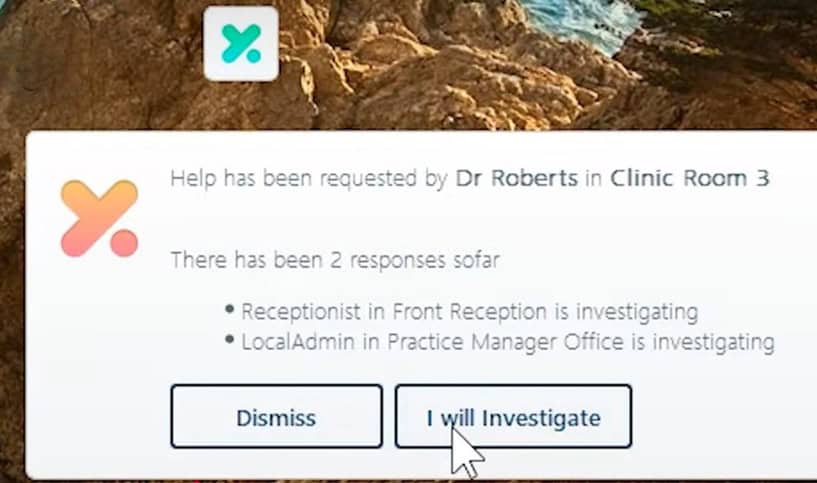
The Exhail system is a desktop-based duress button that allows clinicians to discreetly alert colleagues within the practice. The system appears as a small on-screen icon and can be activated without changing the clinician’s behaviour, sending a silent notification to other staff that assistance is required. It also works “fully offline”, the developers say.
“You can move your mouse and tap it without any noticeable change in what you’re doing with the patient,” Mr Smee said.
Alerts are distributed across the clinic, with staff able to acknowledge and respond, creating a coordinated internal response rather than multiple people reacting at once.
Importantly, Mr Smee said the approach aligns with existing accreditation requirements, which call for practices to have systems and processes in place to support staff safety.
“One of the parts in the RACGP framework is that you need to provide a safe environment for your staff, and a duress system is one way of doing that,” he said.
To support this, ORB has developed policy templates that practices can incorporate into their existing procedures, reducing the burden on practice managers to create documentation from scratch.
The platform has been designed with flexibility in mind, supporting different clinic layouts, multi-site organisations and varied workflows, but Mr Smee said the focus remains on simplicity and reliability in high-pressure situations.
“It looks like a simple button, but there’s a lot of thought behind how it works in a real practice environment,” he said.