


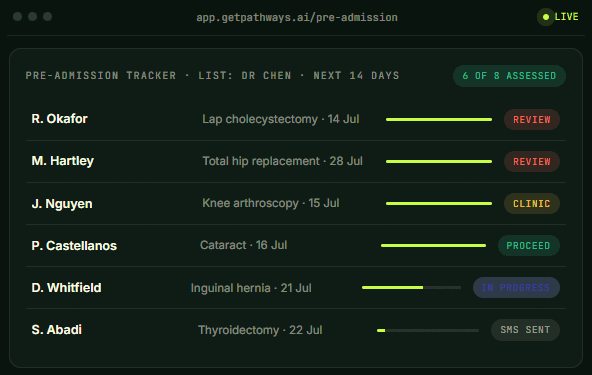
Australian health technology start-up Pathways has developed an AI-powered perioperative assessment platform designed to reduce hospital administration, improve patient access to pre-surgery assessments and give clinicians more time for direct patient care.
The company is targeting inefficiencies across the surgical patient journey – particularly the repeated collection of medical histories, medication details and risk information by different clinical and administrative teams.
Pathways uses conversational voice AI, medication image analysis and clinical risk assessment frameworks to streamline the process from surgical referral through pre-admission, anaesthetic assessment and discharge. A dedicated Record Request agent identifies gaps in patient history, finds the relevant GPs and specialists and requests records on the team’s behalf – returning them securely against a unique patient reference.
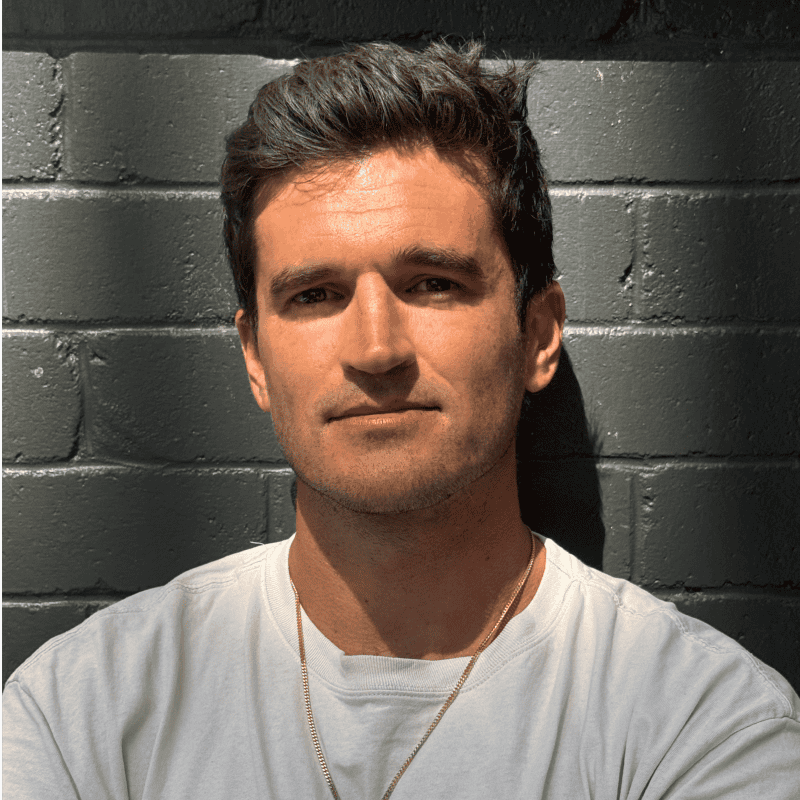
Pathways CEO and co-founder Nick Anderson told Pulse+IT the company had identified an opportunity to reduce duplicated work after speaking with nurses, surgeons, anaesthetists and hospital administrative staff.
“The products we originally built required TGA approval, because they had some deterministic diagnostics within them – so, while those were great products, we thought, ‘Hey, let’s speak to people within these hospitals and figure out where the real time savings can be had’.”
The resulting platform is designed to allow patients to complete much of their preoperative assessment through a voice conversation rather than lengthy paper or online forms.
After a hospital accepts a surgical referral, patients requiring assessment receive an SMS link to a voice agent. With their consent, they can answer questions about their health and photograph their medications for analysis.
The platform identifies potential risks for clinical review, with hospital staff following up where further assessment is required.
Mr Anderson said this approach could be particularly useful for older patients, people with visual impairments and those whose first language is not English.
He said existing processes often required patients to provide the same information multiple times, while conventional digital forms were not always accessible.
Mr Anderson cited Ramsay Health Care’s surgical volumes of approximately 500,000 procedures annually and estimated that preoperative administrative processes could use around 30 to 35 minutes of nursing time per patient.
“That’s a significant opportunity to get nurses back to the bedside, but also, with the existing workforce, deal with what is coming in terms of more hospital occupancy over the next five to 10 years,” he said.
Origin story
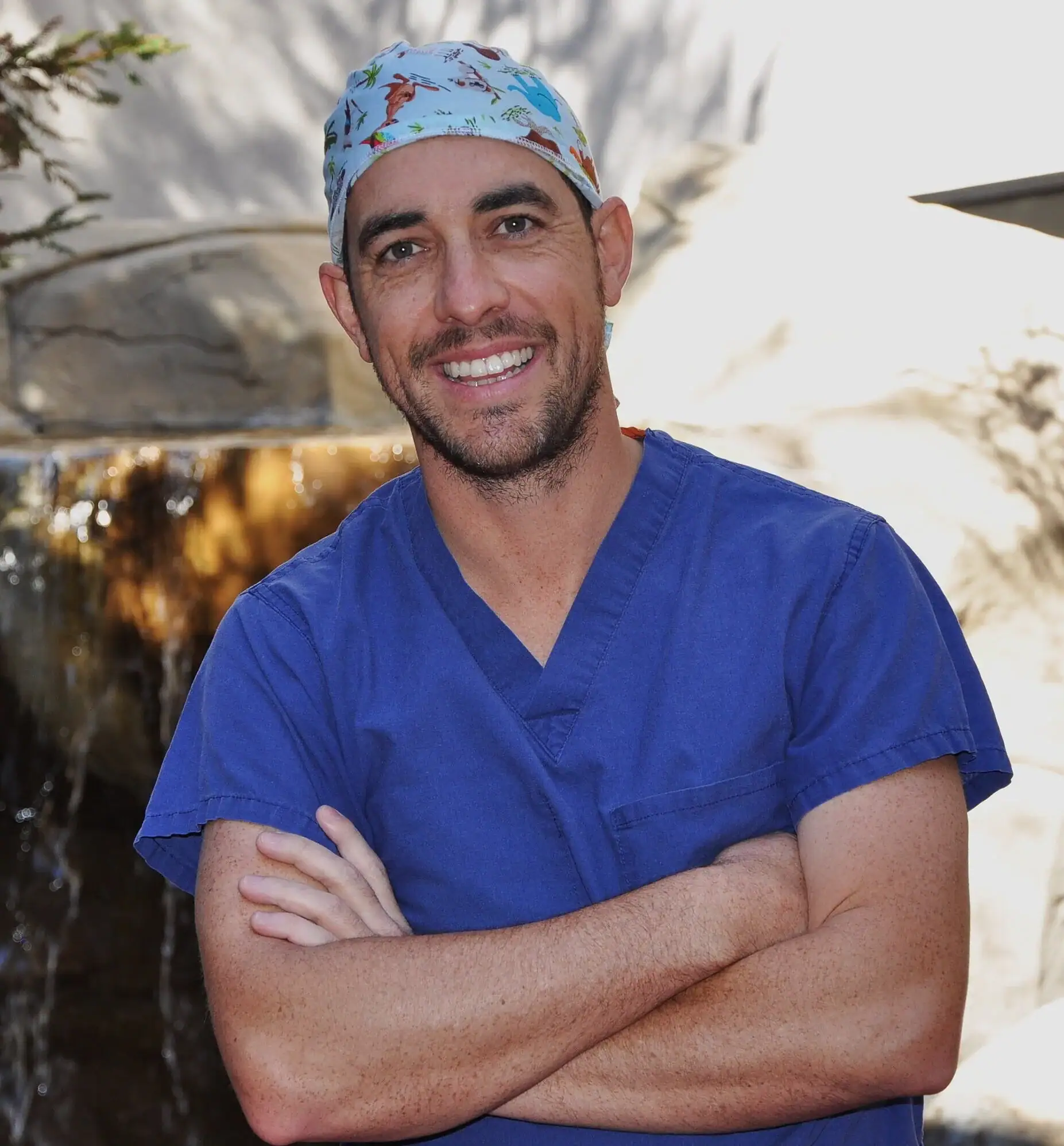
Pathways emerged from a conversation between Mr Anderson and his urologist, robotic urological surgeon Dr Matt Winter, in September 2025.
Mr Anderson had recently undergone surgery for cancer and was discussing his work in enterprise cybersecurity when Dr Winter suggested combining their technical and clinical experience to address hospital workflow problems.
Mr Anderson had spent a decade in enterprise cybersecurity, holding roles at AvePoint, MyCISO, Wiz and Google, where he worked in enterprise sales and go-to-market functions for complex technology products.
His experience with cancer prompted a reassessment of his career priorities and a decision to leave the sector to build Pathways.
“For me, that wasn’t to make as much money as humanly possible. It was to find something that’s going to give me a little bit more purpose through what I’m doing in my life,” he said.
Dr Winter, the company’s chief medical officer and clinical co-founder, is a urologist, uro-oncologist and robotic surgeon specialising in minimally invasive surgery for complex urological conditions. His clinical experience and hospital relationships have helped inform the company’s development.

The third co-founder, Damien Hughes, joined in November 2025. As CTO, Mr Hughes leads product and engineering, bringing nine years of AI product development experience and more than 20 years in technology solutions, strategy and user experience. He has a background in psychology and expertise in reinforcement learning.
Mr Hughes said Pathways was “built from day one around a simple principle: AI should give clinicians and nurses time back without ever taking clinical judgement away from them.”
“Our proprietary clinical harness keeps every model tightly scoped to what it does best, extracting structured information from voice agent transcripts and patient history that our agents collect, while triage and escalation decisions run on deterministic, versioned clinical rules that hospitals can audit line by line.”
Mr Hughes said patient data remained onshore, with Anthropic’s Claude models running on AWS Bedrock in Sydney and ElevenLabs providing conversational voice capabilities.
“Combining best-in-class models inside a clinical safety layer we control means hospitals get frontier AI capability with the governance, data residency and transparency Australian healthcare demands.”
Together, the founders bring expertise in cybersecurity and commercialisation, clinical practice and AI engineering. Mr Anderson said the company was currently self-funded, with a small team drawing on their respective professional networks.
Clinical governance and integration
A key part of Pathways’ offering is a clinical governance framework designed to check AI-generated assessments and reduce the risk of unreliable outputs.
Mr Anderson said a 12-check clinical validation system applied to decisions and risk assessments, including work involving frailty, cardiac and diabetes-related risks.
“It’s the harness, which is the specific clinical harness we built, that is the differentiator,” he said.
The company is also developing ways to gather existing patient information, including pathology results, to avoid asking questions that have already been answered elsewhere in the health system.
Pathways is exploring integration with hospital electronic medical records, including Epic, but has designed its platform to operate independently where integration would require significant IT work.
“We don’t require an integration with a specific system. We can be a standalone product without requiring a large IT project for providers,” Mr Anderson said.
The company is also working on integration with Magentus practice management software, including Genie and Gentu, to allow visiting medical officers to send surgical lists directly into participating hospitals’ Pathways systems.
First implementations
Pathways has been implemented at Royal North Shore Hospital (RNSH) in Sydney, where its use is being clinically validated through an initiative supported by a $100,000 Northern Sydney Local Health District grant.
RNSH director of perioperative medicine Dr Andrew Marks, who championed the grant initiative and leads the hospital’s use of Pathways, said the technology could help identify surgical risks earlier and improve access to preoperative screening.
“Pre-admission is where surgical risk is either caught or missed. Pathways gives our teams a complete, risk-based, structured picture of each patient – well before the day of surgery – so we can act early, reduce avoidable cancellations, increase patient screening for frail, or non-English speaking, or visually impaired patients – and refocus clinical time where it matters most.”
Dr Marks is also a clinical lecturer at the University of Sydney and senior anaesthetist at North Shore Private Hospital and Sydney Adventist Hospital.
Mr Anderson said the company’s longer-term objective was to help hospitals accommodate growing surgical demand without proportionately increasing administrative workloads.
“We want to bring awareness to the fact that there’s a different approach out there. It’s cost effective. It’s quick to implement,” he said, noting the aim was to give nurses and clinicians more time to care for patients rather than staring at computers.
