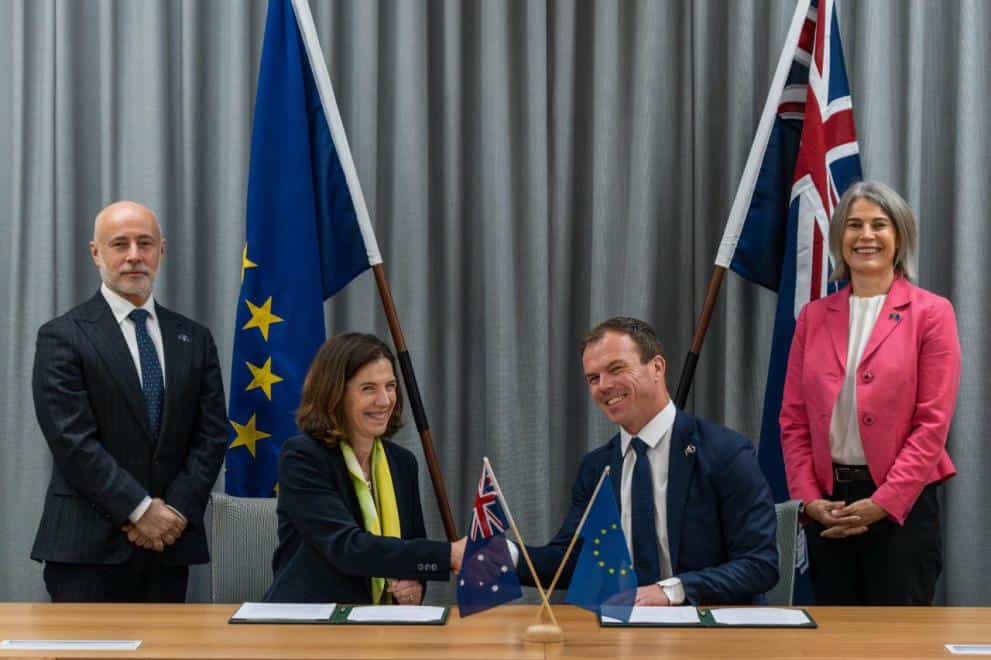
Australian health and medical researchers are a step closer to participating directly in the European Union’s flagship research and innovation programme after the European Commission and Australian Government concluded negotiations on Australia’s association with Horizon Europe.
The European Commission confirmed the successful completion of negotiations would allow Australia to associate to Pillar II of Horizon Europe – subject to the completion of domestic treaty-making and ratification processes.
It follows exploratory discussions launched last year regarding Australia’s possible association with Horizon Europe – the European Union’s €93.5 billion research and innovation programme for 2021-2027.
Association means Australian researchers and organisations will be able to participate in and lead collaborative research projects funded through Pillar II – which focuses on global challenges and industrial competitiveness and includes health and digital research.
When discussions were announced last year, the European Commission noted that Horizon Europe’s 2025-2027 strategic plan included a Health Cluster work programme focused on strengthening healthcare resilience, leveraging biotechnology and artificial intelligence and addressing public health needs.
The Commission said Australia would become the second Indo-Pacific country to associate to Horizon Europe, following New Zealand’s association in 2023.
According to the Commission, Australian organisations have already participated in 239 Horizon Europe projects, with nearly one in four individual applications from Australia selected for participation.
Previously, the National Health and Medical Research Council has pointed to a number of Horizon Europe opportunities across a range of health and medical research areas.
These include projects focused on climate-resilient healthcare systems, digital technologies for health, youth mental health, cardiovascular disease, long-term health impacts following infection, personalised medicine, medical devices and patient-centred health technologies.
The Commission said association to Horizon Europe represents the closest form of international cooperation in science and technology between the European Union and non-EU countries, with 22 countries currently associated with the programme.
European Commissioner for Startups, Research and Innovation Ekaterina Zaharieva said “We can tackle the challenges of tomorrow only together – that is why the future of science and technology depends on strong international partnerships, like the one between the EU and Australia.
“By combining our strengths, we will drive the next generation of transformative innovations.”
The Commission noted Australia and the European Union had a long history of research collaboration – including a science and technology cooperation agreement signed in 1994 and existing arrangements supporting collaboration between European researchers and those funded by the Australian Research Council and National Health and Medical Research Council.
The agreement is expected to enter into force in 2027 once the required approval processes have been completed.